
Stake Crypto Casino Payments: Deposits, Withdrawals and Fees
Stake Payment Methods: A Wallet of Coins
Payment methods on Stake start with the cryptocurrency wallet. Each supported coin keeps its own balance, so 0.01 BTC, 50 USDT and 2 SOL sit side by side instead of merging into one dollar total. In settings you can switch the display to USD or EUR, among other currencies. That figure is an indicative conversion at market price, because every transaction settles in crypto.
Stake crypto gambling differs from a cash account in one practical way: the price risk sits with you. Lose 0.01 BTC on a bet and the loss is 0.01 BTC. That stays true whatever Bitcoin does next, and ETH held between sessions moves with the market as well, up or down, until you spend or withdraw it. A stablecoin such as USDT or USDC is pegged to USD, which keeps the displayed value steady.

Four Routes Into and Out of the Stake Crypto Casino
Crypto on Stake enters and leaves the wallet through four routes:
- Crypto deposit: any of the 21 coins sent to the address under Wallet → Deposit;
- Buy Crypto: MoonPay takes Visa, Mastercard, Apple Pay or Google Pay and delivers the coin to your balance;
- Swapped.com and Mesh: two more ways to buy crypto or move it in from an exchange;
- Withdrawal: crypto to an address you control, plus card or bank payouts in some local-currency markets after a 100% wager of the fiat deposit.
Stake Bitcoin and 20 Other Coins
Bitcoin deposits on Stake are the most common, and BTC sits at the top of the coin menu. The wallet takes 21 coins in total: BTC, ETH, LTC, DOGE, BCH, TRX, EOS, USDT, BNB, CRO, USDC, APE, DAI, LINK, SAND, SHIB, UNI, MATIC, SOL, XRP, as well as TRUMP.
Each coin moves on its own chain with its own confirmation time and fee. That is the biggest single factor in real speed. A Bitcoin block takes about 10 minutes and a Litecoin block about 2.5 minutes, and Bitcoin fees climb during chain congestion, while Litecoin and Dogecoin usually cost less to move in small amounts and USDT keeps a stable dollar value for larger transfers. Minimums and fees for withdrawals are set per coin, in coin units:

| Coin | Chain | Minimum withdrawal | Withdrawal fee |
|---|---|---|---|
| BTC | Bitcoin | 0.00002504 BTC | 0.00001571 BTC |
| ETH | Ethereum | 0.001 ETH | 0.00067447 ETH |
| LTC | Litecoin | 0.01857329 LTC | 0.000138 LTC |
| DOGE | Dogecoin | 5.4992597 DOGE | 0.52151198 DOGE |
| SOL | Solana | 0.01050998 SOL | 0.000005 SOL |
| XRP | XRP Ledger | 1 XRP | 0.0001 XRP |
| TRX | Tron | 7.82408913 TRX | 0.0733617 TRX |
| BCH | Bitcoin Cash | 0.00405806 BCH | 0.00004 BCH |
| USDT | Stablecoin | 2.50 USDT | 1.00 USDT |
| USDC | Stablecoin | 2.50 USDC | 1.00 USDC |
Minimum Deposits by Coin
The minimum deposit on Stake is set per coin and shifts with its price, so there is no single dollar figure. Confirm the current minimum in the Wallet before you send. Card deposits in supported local currencies run from $5 to $1,000 per transaction in USD and euros, and the 200% welcome match needs at least $10. Large aggregate deposits can bring a Level 4 source-of-funds check.
How to Deposit on Stake, Step by Step
How you deposit on Stake depends on whether you already hold coins. Level 2 verification, a photo ID plus a selfie, is mandatory for every account, so finishing it before the first transfer keeps the money moving.
Sending Crypto From Your Own Wallet
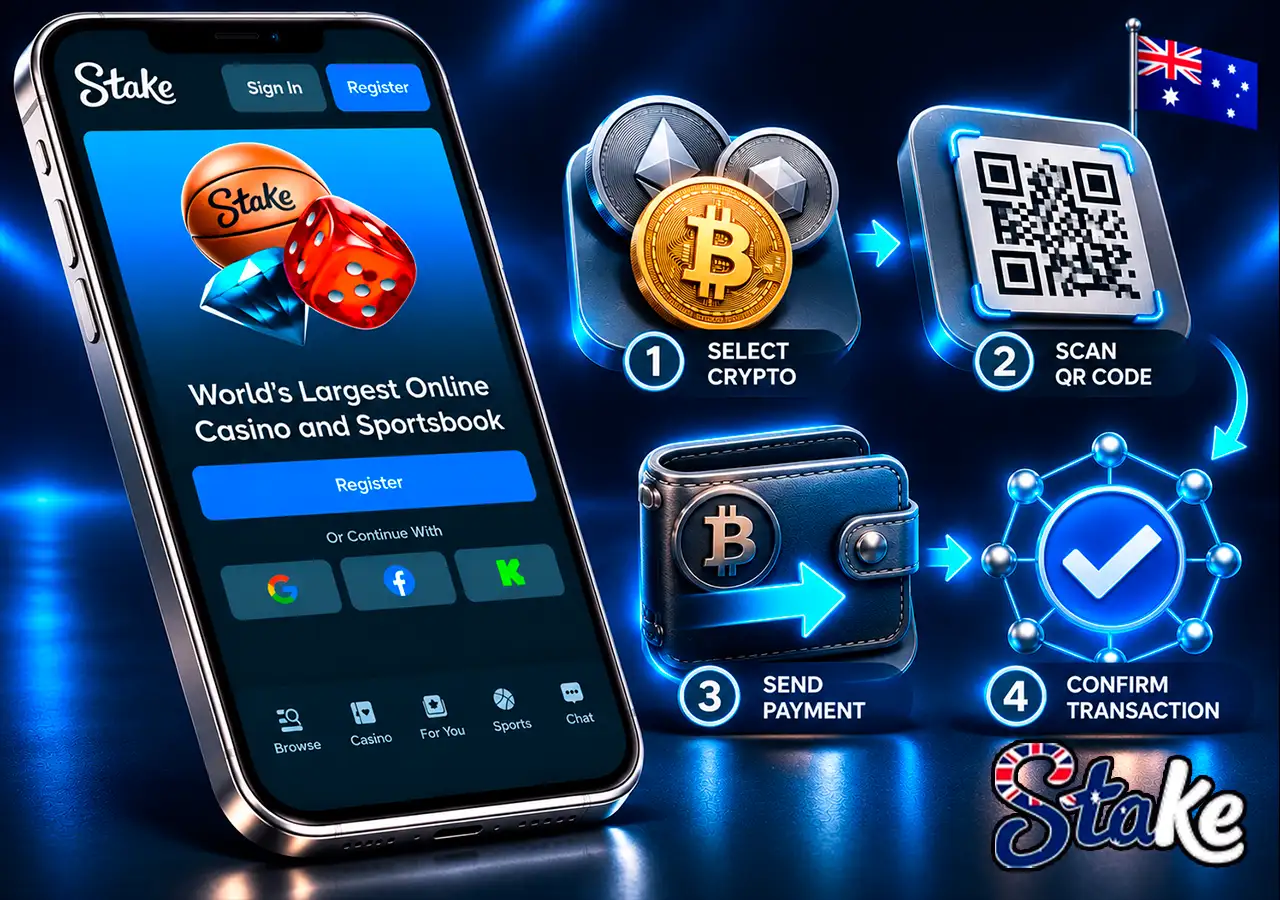
The Stake deposit time starts with the blockchain confirmation, and the coin appears in its balance once the network confirms. Sending coins in takes 5 steps:
- Open Wallet and choose Deposit.
- Pick the coin and copy the deposit address shown for it.
- If the screen shows a destination tag for XRP or a memo for EOS, copy that too.
- Paste the address, and the tag or memo, into the send field of your external wallet or exchange.
- Confirm the transfer and wait for the network confirmation.
Buying Crypto Inside Stake
The Buy Crypto tab hands the payment to MoonPay. Pick the coin, choose a card, Apple Pay or Google Pay, enter the amount and finish the checkout, and the coin lands in your balance. A deposit on Stake through MoonPay is a purchase first, so the card issuer approves the payment before MoonPay sends the coin:
| Route | Pay with | Lands in the wallet as |
|---|---|---|
| MoonPay through Buy Crypto | Visa, Mastercard, Apple Pay, Google Pay | The coin you bought |
| Swapped.com | A fiat purchase of crypto | The coin you bought |
| Mesh | Crypto from a connected exchange account | The coin you moved |
| Local currency deposit | A method set by the currency | A balance in that currency |
Stake Withdraw Speed: Three Things Decide It
A crypto payout settles in minutes on most chains, but the full time is the sum of three parts. Knowing how to quickly withdraw from Stake starts with the coin, because the chain is the part you choose: Litecoin confirms a block in about 2.5 minutes and Bitcoin in about 10, and congestion on Bitcoin or Ethereum stretches both. Verification comes second. Stake can hold a withdrawal until the KYC level it asks for is complete, and Level 3 proof of address appears once withdrawal volumes grow. Processing sits on Stake’s side and takes minutes for crypto on most chains, which leaves the chain and KYC as the parts that decide how long you wait.
| Factor | Fastest case | Slowest case | What you control |
|---|---|---|---|
| Chain | Litecoin, a block about every 2.5 minutes | Bitcoin or Ethereum under congestion | The coin you withdraw in |
| Verification | Level 2 done before the first win | Level 3 or 4 requested at withdrawal | Finishing KYC early |
| Stake processing | Minutes on most chains | Account under review | Nothing, it sits with Stake |
Sending Coins Out
In most markets there is no route from crypto back to a card. Coins go to an address you control, and turning them into cash is a separate step on an exchange you already use. In some local-currency markets Stake also lets you withdraw to a card or bank account, which takes up to three business days and needs a 100% wager of the fiat deposit first. The steps for how to withdraw money on Stake in crypto are the same for every coin:
- Open Wallet and choose Withdraw.
- Pick the coin and check its minimum withdrawal.
- Paste an address you control on the same chain, with a tag or memo if the receiving wallet needs one.
- Confirm the amount, knowing the coin’s withdrawal fee comes off it.
KYC: Four Levels Before a Large Withdrawal
Stake verifies accounts in four levels. Level 2 is mandatory for every player, and finishing it before winnings exist is the main part of how to withdraw on Stake without a hold. Clear scans of the ID avoid a Level 2 resubmission. Paying in crypto does not skip any of the verification tiers:
- Level 1: name, date of birth and residential address, completed instantly at signup;
- Level 2: a government-issued photo ID plus a matching selfie, approved within minutes to a few hours;
- Level 3: proof of address dated within the last six months, requested at higher withdrawal volumes;
- Level 4: source of funds, requested for large aggregate deposits or under AML checks.

Fees: Operator, Processor, Network
Three parties can take a cut on the way in and out, and only one of them is Stake. Stake adds no fee of its own to crypto deposits. MoonPay charges its own fee and a spread when it sells you a coin, and that cost sits with MoonPay, not with the casino.
The network fee comes last. Every move pays the chain, and on Ethereum it takes the form of a gas fee that rises with traffic. On a Stake withdrawal the fee is deducted from the amount rather than added on top, so sending the 2.50 USDT minimum leaves 1.50 USDT after the 1.00 USDT fee. For small balances, how to withdraw your funds from Stake without losing a large share comes down to the chain: Litecoin or Tron fees are fractions of a coin, while USDT and ETH fees take a bigger bite of a small amount.
Stake Crypto Casino FAQ
-
How do you withdraw money from Stake to a bank card?In most markets withdrawals go to a crypto address. Some local-currency markets add card and bank payouts, taking up to three business days after a 100% wager of the fiat deposit.
-
How long does a crypto payout take?At Stake, how long it takes to withdraw depends mostly on the chain: minutes on most chains once verification is complete. Bitcoin under congestion and a pending KYC level add the most time.
-
Is Stake crypto-only?Crypto is the core of the wallet, with 21 coins. Some markets also take local currencies, and MoonPay sells crypto for card, Apple Pay and Google Pay payments.
-
Does Stake accept PayPal?Stake lists no PayPal option. Card, Apple Pay and Google Pay payments go through MoonPay, which delivers crypto to the wallet.
-
What if a chain is congested?The transfer waits longer for confirmation, and the network fee usually rises. A less busy chain, such as Litecoin or Tron, avoids most of the delay.
-
What is the minimum withdrawal?It is set per coin: 2.50 USDT, 0.001 ETH or 0.00002504 BTC, for example, with each coin’s fee deducted from the amount.
-
What happens if KYC is rejected?The withdrawal stays on hold until a clear document passes the requested level, so a resubmission is the usual fix.