
Stake Originals: In-House Games Guide (2026)
What Provably Fair Proves and What It Doesn’t
Provably fair is a commit-and-reveal check that Stake applies to every in-house title. It shows that the outcome was locked before your bet and that nobody changed it afterwards. That rules out post-hoc tampering, a class of cheating that a regular online slot with a closed RNG cannot rule out as easily from the player’s side.
It leaves the house edge untouched. Plinko at Stake keeps 1% over time whether you verify every drop or none, and no check makes a game favourable to the player or tells you whether the next round wins.
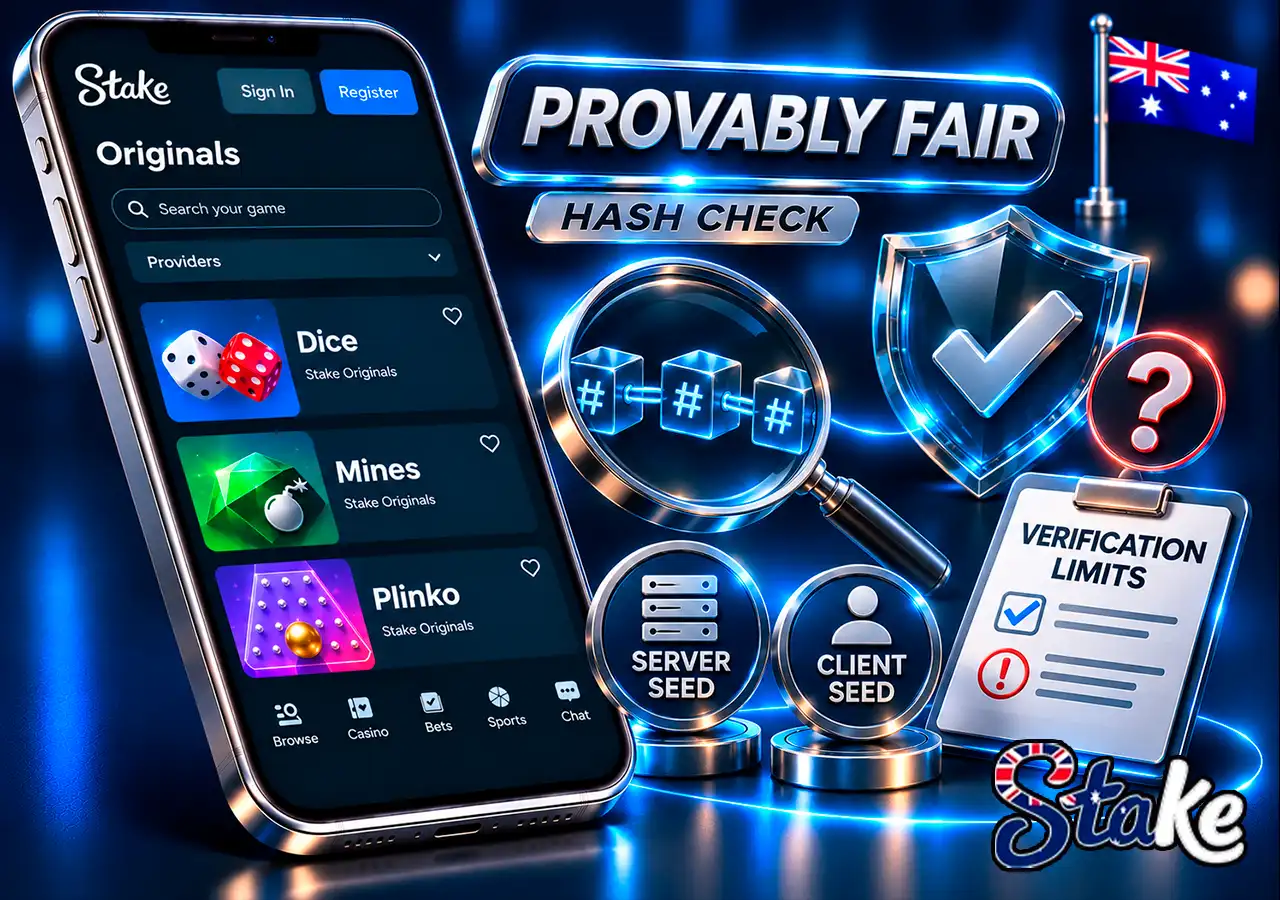
The check itself runs in four steps behind the fairness button:
- Before you bet, Stake generates a server seed and shows you only its hash, a fingerprint that cannot be reversed.
- Your client seed joins it, and you can keep the suggested one or type your own.
- A nonce counts every bet on that seed pair, so round 1 and round 50 each get a unique input.
- When you rotate to a new seed pair, Stake reveals the old server seed, so you can hash it, match it to the fingerprint and recalculate every past round.
The Core Stake Originals Line-up
Eight of the 31 titles cover most of what players open first, each with its own mechanic and risk profile. Many of them let you set the volatility before the round starts.

| Game | Type | Core mechanic | Risk feel |
|---|---|---|---|
| Plinko | Instant-win | Ball drops through pins into multiplier buckets | Low to high, set by risk level and rows |
| Mines | Mine-sweeper grid | Reveal tiles, avoid the mines | Player-controlled through mine count |
| Crash | Crash-style curve | Cash out before the curve crashes | Grows the longer you hold |
| Limbo | Multiplier target | Pick a target, win if the result reaches it | Fast, one result per bet |
| Dice | Classic roll | Roll over or under a chosen number | Steady, measurable |
| Keno | Lottery-style | Pick numbers, match the draw | Low frequency, high variance |
| HiLo | Card prediction | Guess higher or lower on each card | Streak-driven |
| Wheel | Spin-the-wheel | Pick a risk level, spin for a multiplier | Chosen in advance |
Stake Plinko: Risk Levels and Rows
Plinko on Stake borrows its board from the Japanese pachinko parlour. A ball drops through a pyramid of pins into one of the payout buckets along the bottom, and before the drop you set the bet size, the risk level (low, medium or high) and the number of rows, from 8 to 16. Plinko pays up to 10,000×. That top multiplier sits in the outer buckets at high risk, while the centre buckets, where most balls land, pay less as the risk goes up. The house edge is 1%, an RTP of 99%, and no row count or risk level turns it in your favour.
Stake Mines and the Calculator Question
Stake Mines plays on a 5×5 grid of 25 tiles, and before the round you decide how many mines hide under them. The range is 1 to 24. Each safe tile you reveal raises the multiplier, and cashing out ends the round with that payout locked in, while a mine ends it with the bet lost.
The multiplier for any mine count and number of revealed tiles is fixed maths, and a calculator for Stake Mines computes it: the chance that the next tile is safe and the payout it would bring. As an odds tool it helps you read the game. It cannot predict where the mines sit, because the positions come from your seed pair and nonce, and the server seed stays hidden until you rotate it.
Mines at Stake runs only inside the Stake lobby. Imitation Mines sites copy the grid and the logo, and logging in there risks handing your credentials to a third party. The same goes for any Stake-branded app in Google Play or the App Store, because Stake installs as a web app from its own mobile site.
Stake Crash and Auto Cash-Out
Crash at Stake starts the multiplier at 1.00× and lets it climb until it crashes at a random point, anywhere up to 1,000,000×. Cash out before the crash and the bet pays at the multiplier on screen. A crash before cash-out loses the bet.
Auto cash-out is the setting that matters most for self-control. You enter a target, say 2.00×, before the round, and the game cashes out the moment the curve reaches it. Rounds start back to back, so a short session can hold far more bets than planned. At this tempo, a single-wager limit and a daily loss cap set in your account keep each session inside a fixed budget, and Break In Play pauses the account for one day, two days or up to a month. Gambling Help Online answers on 1800 858 858 around the clock.
Where Originals Sit Next to Stake Slots
The 31 in-house titles sit as a small shelf next to more than 8,500 third-party slots from studios such as Pragmatic Play, Play’n GO, Hacksaw Gaming and Nolimit City, plus 177 live tables led by Evolution. Originals are the games built for Stake.com and the only part of the library Stake can change or extend without a provider.
Slots on Stake from third-party studios use each provider’s own RNG, certified under the Curaçao licence OGL/2024/1451/0918 held by Medium Rare N.V., and a spin leaves no seed pair to inspect. The in-house slots, Blue Samurai among them, belong to Originals and use the same seed system as Dice. For readers in Australia comparing Stake slots with Originals, the difference comes down to one point: a slot’s fairness rests on lab certification, an Original’s on a check you can run yourself.

Stake Originals FAQ
-
What are the Originals on Stake?They are 31 in-house games built for Stake Casino, from Plinko to Blackjack, all running on provably fair code.
-
Can you play Originals outside Stake.com?No. These games are exclusive to Stake users, so a game under the Stake name elsewhere or in an app store is a copy, not the official title.
-
Can a Mines calculator predict wins?No. A calculator shows the odds and payout for each revealed tile, but mine positions come from your seed pair and nonce and stay hidden until revealed.
-
What does provably fair prove?It proves the result was fixed before your bet and not changed afterwards. It does not lower the house edge or tell you whether the next round wins.
-
What is the fastest Original on Stake?Limbo. You set a target from 1.01× to 1,000,000×, and each bet returns one instant result with no curve to watch.
-
Are fake Stake Mines sites real?No. They copy the grid and logo, but Stake does not run them, and logging in there can hand your credentials to a third party.
-
What is the house edge on the Originals?Plinko and Limbo on Stake each carry a 1% house edge, an RTP of 99%. Provably fair checks confirm each result without changing that edge.